



Search, compare and book your train tickets in Asia
Select your departing trip
Results from Da Nang to Ho Chi Minh on Wednesday, 23 September 2026
Flight routes from Da Nang to Ho Chi Minh
| Departure | Arrival | Price | ||||
|---|---|---|---|---|---|---|

VJ631
1h 20m
|
23:00
We, 23/09
DA NANG DAD |
00:20
Th, 24/09
HO CHI MINH SGN |
1,121,781 đ
|

|
||

VN101
1h 35m
|
05:45
We, 23/09
DA NANG DAD |
07:20
We, 23/09
HO CHI MINH SGN |
1,307,181 đ
|
|
||

VN6037
1h 35m
|
13:50
We, 23/09
DA NANG DAD |
15:25
We, 23/09
HO CHI MINH SGN |
1,395,181 đ
|
|
||
Train routes from Da Nang (Da Nang Railway Station) to Ho Chi Minh (Saigon Railway Station)
| Departure | Arrival | Price | ||||
|---|---|---|---|---|---|---|

SE5
17h 44m
|
00:36
We, 23/09
DA NANG Da Nang |
18:20
We, 23/09
HO CHI MINH Saigon |
695,000 đ
|
|
||

SE21
20h 40m
|
07:55
We, 23/09
DA NANG Da Nang |
04:35
Th, 24/09
HO CHI MINH Saigon |
2,300,000 đ
|
|
||

SE3
18h 47m
|
10:43
We, 23/09
DA NANG Da Nang |
05:30
Th, 24/09
HO CHI MINH Saigon |
2,200,000 đ
|
|
||
Bus routes from Da Nang to Ho Chi Minh
| Departure | Arrival | Price | ||||
|---|---|---|---|---|---|---|

20h 23m
|
10:15
We, 23/09
DA NANG Central |
06:38
Th, 24/09
HO CHI MINH Mien Tay |
560,000 đ
|
|
||

Our pricing policy is transparentThe fares displayed have been obtained directly from the transport providers and do not include any mark-ups. Please note that prices do not include our service fee. The total price including any additional fees will be displayed before payment.
Our platform is trusted by travelersWe are recommended by leading independent travel guides such as Lonely Planet, DK Eyewitness, Rough Guides, Insight Guides, DuMont Reise-Handbuch, Le Routard and others. Travelers consistently praise the quality of our service, so you can rely on us to plan your trip and book with confidence.
How to get from Da Nang to Ho Chi Minh
There are three ways to travel from Da Nang to Ho Chi Minh: by plane, by train and by bus.
How far is Ho Chi Minh from Da Nang?
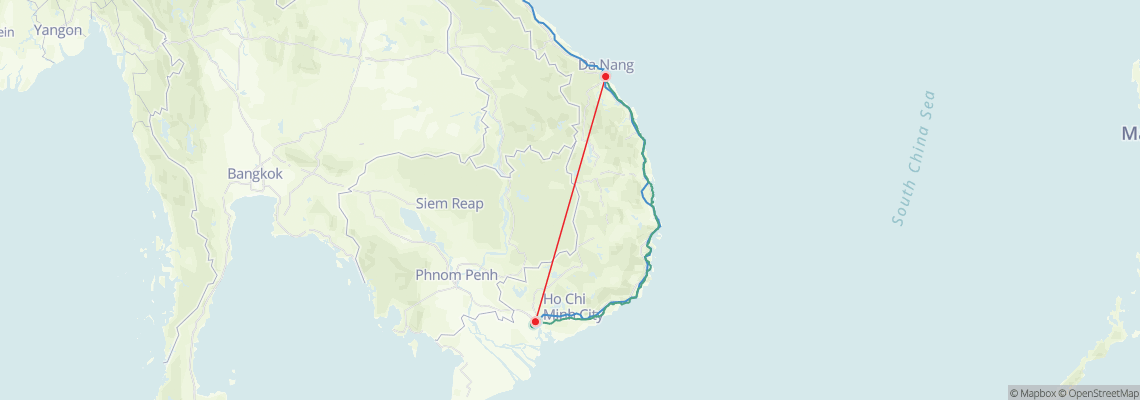
The travel distance between Da Nang and Ho Chi Minh is 945 km. There are three options to travel from Da Nang to Ho Chi Minh: taking a flight, a train or a bus.
How long does it take to get from Da Nang to Ho Chi Minh?
It takes 1 hour 30 minutes to get from Da Nang to Ho Chi Minh by plane, 17-26 hours by train and 20-25 hours by bus.
Depending on the traffic, sometimes the bus arrives 30 minutes earlier or later than scheduled. The plane and the train usually depart and arrive on time.
How to get from Da Nang to Ho Chi Minh by plane
There are four domestic airlines operating the route Da Nang to Ho Chi Minh: Vietnam Airlines (VN), Bamboo Airways (QH), Pacific Airlines (BL) and VietJet Air (VJ).
For more information about travelling by plane, please read our Flight Guide in Vietnam.
How to get from Da Nang to Ho Chi Minh by train
There are two types of train services running the route Da Nang to Ho Chi Minh that are managed by two operators: Vietnam Railways and private railway companies.
The state-owned railway company Vietnam Railways operates its own set of passenger coaches. Passenger cars are divided in four classes: Hard seat, Soft seat, Soft bed in compartments for 1-4 passengers and Hard bed in compartments for 1-6 passengers.
The private railway companies Violette Trains and Charmy Express operate their own passengers cars attached to the trains hauled by Vietnam Railways, hence depart and arrive according to the same schedule. The coaches operated by the private railway companies provide a higher level of comfort, with luxury cabins decorated with wooden floor and cozy soft beds. The service also includes bottled water and snacks. Passenger cars are divided in two classes: Sleeper 2-Berth in compartments for 1-2 passengers and Sleeper 4-Berth in compartments for 1-4 passengers.
For more information about travelling by train, please read our Train Guide in Vietnam.
Where do trains from Da Nang to Ho Chi Minh depart?
Trains on the North-South railway line depart from Da Nang Railway Station located at 202 Hai Phong, Tân Chinh Ward, Thanh Khe District, Đa Nang.
Please arrive to the station 30 minutes before the scheduled departure time to complete the boarding procedures or risk missing the train.
Where do trains from Da Nang to Ho Chi Minh arrive?
Trains on the North-South railway line arrive at Saigon Railway Station located at 09 Nguyen Thong, Ward 9, District 3, Ho Chi Minh.
Why you should book your trains in Vietnam with Baolau?
You can compare transport options and see the available schedules and fares offered by Vietnam Railways and the private railway companies side by side, then you can choose the option that works best for your trip.
Depending on the operator you will be able to view the available seat map during the reservation process and select your seat or berth, or at least indicate your preference regarding upper or lower berth and we will carefully select the best places for you and your travel company.
Baolau is an official ticket agent of Vietnam Railways since 2015 and works directly with the major private railway companies in Vietnam, facilitating advance ticket reservations and providing direct customer support without any intermediaries.
Once you select your desired travel option, you can pay using international credit or debit cards, Google Pay, Apple Pay, Alipay and other available local payment methods. Your booking request will be processed immediately and you will receive your booking confirmation with your electronic ticket attached by email, ready to keep it on your phone or print it before departure.
How to get from Da Nang to Ho Chi Minh by bus
There are two bus companies running the route Da Nang to Ho Chi Minh.
Phuong Trang (Futa Bus) operates double-deck sleeper buses equipped with fixed berths and capacity for 40–44 passengers.
Queen Cafe operates double-deck sleeper buses equipped with fixed berths and capacity for 32 passengers.
For more information about travelling by bus, please read our Bus Guide in Vietnam.
Where do buses from Da Nang to Ho Chi Minh depart?
Most buses from Da Nang to Ho Chi Minh from Da Nang depart from Da Nang Central Bus Station located at 201-203 Ton Duc Thang, Hoa Minh, Lien Chieu, Da Nang.
Please arrive to the point of departure at least 30-60 minutes before the scheduled departure time. Note that some bus companies will organize the transfer of passengers from the point of departure to the bus terminal by shuttle bus, therefore customers must show up in advance or risk missing the bus.
Where do buses from Da Nang to Ho Chi Minh arrive?
Most buses from Da Nang to Ho Chi Minh arrive at Mien Tay Bus Station located at 395 Kinh Duong Vuong, An Lac Ward, Binh Tan District, Ho Chi Minh.
Why you should book your buses in Vietnam with Baolau?
You can compare buses, minibuses and minivans, and see the available departure times and prices aggregated from different bus operators side by side, then you can choose the option that works best for your trip.
Depending on the operator you will be able to view the available seat map during the reservation process and select your seat or berth, or at least indicate your preference regarding upper or lower berth and we will carefully select the best places for you and your travel company.
Baolau thoughtfully curates the bus inventory in Vietnam and only works with trusted and reputable bus companies, guaranteeing the ticket reservation, ensuring a safe journey by road and providing dedicated customer support when things go wrong.
Once you select your desired travel option, you can pay using international credit or debit cards, Google Pay, Apple Pay, Alipay and other available local payment methods. Your booking request will be processed immediately and you will receive your booking confirmation with your electronic ticket attached by email, ready to keep it on your phone or print it before departure.
Where to travel next from Ho Chi Minh
From Ho Chi Minh, you can go by bus to Phan Thiet, Mui Ne, Da Lat, Nha Trang, Can Tho or fly to Buon Ma Thuot, Pleiku, Phu Quoc and Con Dao.