



Search and book flights, trains, buses and ferries in Asia
Select your departing trip
Results from Hanoi to Hue on Monday, 06 April 2026
Flight routes from Hanoi to Hue
| Departure | Arrival | Price | ||||
|---|---|---|---|---|---|---|

VN1541
1h 20m
|
05:40
Mo, 06/04
HANOI HAN |
07:00
Mo, 06/04
HUE HUI |
1,940,000 đ
|

|
||

VJ563
1h 15m
|
09:20
Mo, 06/04
HANOI HAN |
10:35
Mo, 06/04
HUE HUI |
2,344,000 đ
|
|
||
Train routes from Hanoi to Hue
| Departure | Arrival | Price | ||||
|---|---|---|---|---|---|---|

SE7
13h 53m
|
06:00
Mo, 06/04
HANOI Hanoi |
19:53
Mo, 06/04
HUE Hue |
640,000 đ
|
|
||

SE3
12h 39m
|
19:20
Mo, 06/04
HANOI Hanoi |
07:59
Tu, 07/04
HUE Hue |
1,900,000 đ
|
|
||

SE3
12h 39m
|
19:20
Mo, 06/04
HANOI Hanoi |
07:59
Tu, 07/04
HUE Hue |
2,100,000 đ
|
|
||

SE3
12h 39m
|
19:20
Mo, 06/04
HANOI Hanoi |
07:59
Tu, 07/04
HUE Hue |
Sold out
|
|
||

SE3
12h 39m
|
19:20
Mo, 06/04
HANOI Hanoi |
07:59
Tu, 07/04
HUE Hue |
Sold out
|
|
||

SE19
13h 11m
|
19:45
Mo, 06/04
HANOI Hanoi |
08:56
Tu, 07/04
HUE Hue |
Sold out
|
|
||

SE19
13h 11m
|
19:45
Mo, 06/04
HANOI Hanoi |
08:56
Tu, 07/04
HUE Hue |
Sold out
|
|
||

SE19
13h 11m
|
19:45
Mo, 06/04
HANOI Hanoi |
08:56
Tu, 07/04
HUE Hue |
Sold out
|
|
||
Bus routes from Hanoi to Hue
| Departure | Arrival | Price | ||||
|---|---|---|---|---|---|---|

12h 30m
|
16:30
Mo, 06/04
HANOI Hoan Kiem |
05:00
Tu, 07/04
HUE Phuong Duc |
750,000 đ
|
|
||

14h 00m
|
17:00
Mo, 06/04
HANOI Hoan Kiem |
07:00
Tu, 07/04
HUE Phu Hoi |
650,000 đ
|
|
||

13h 00m
|
17:00
Mo, 06/04
HANOI Hai Ba Trung |
06:00
Tu, 07/04
HUE Vy Da |
700,000 đ
|
|
||

10h 00m
|
18:30
Mo, 06/04
HANOI Cau Giay |
04:30
Tu, 07/04
HUE Nguyen Hoang |
600,000 đ
|
|
||

10h 20m
|
19:00
Mo, 06/04
HANOI Hoan Kiem |
05:20
Tu, 07/04
HUE Phu Hoi |
750,000 đ
|
|
||

Our pricing policy is transparentThe fares displayed have been obtained directly from the transport providers and do not include any mark-ups. Please note that prices do not include our service fee. The total price including any additional fees will be displayed before payment.
Our platform is trusted by travelersWe are recommended by leading independent travel guides such as Lonely Planet, DK Eyewitness, Rough Guides, Insight Guides, DuMont Reise-Handbuch, Le Routard and others. Travelers consistently praise the quality of our service, so you can rely on us to plan your trip and book with confidence.
How to get from Hanoi to Hue
There are three ways to travel from Hanoi to Hue: by plane, by train and by bus.
How far is Hue from Hanoi?
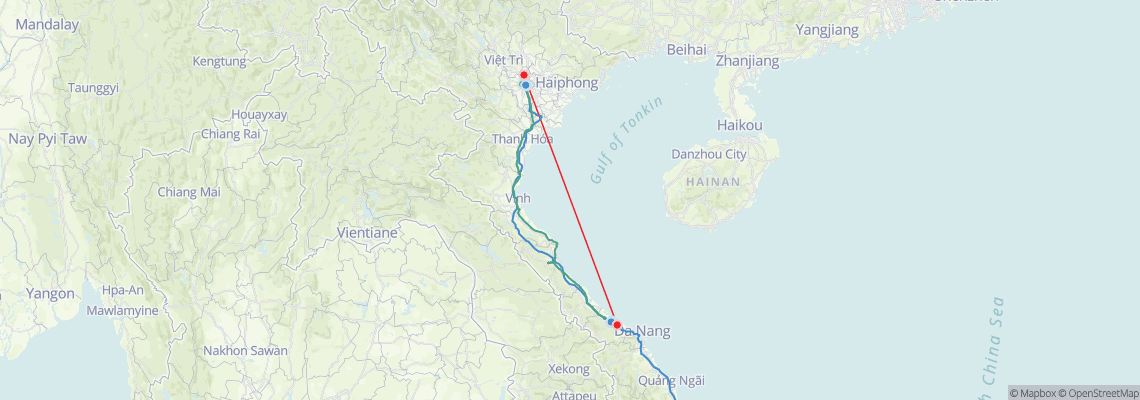
The travel distance between Hanoi and Hue is 668 km. There are three options to travel from Hanoi to Hue: taking a flight, a train or a bus.
How long does it take to get from Hanoi to Hue?
It takes 1 hour 15 minutes to get from Hanoi to Hue by plane and 12-14 hours by train or by bus.
Depending on the traffic, sometimes the bus arrives 30 minutes earlier or later than scheduled. The plane and the train usually depart and arrive on time.
How to get from Hanoi to Hue by plane
There are three domestic airlines operating the route Hanoi to Hue: Vietnam Airlines (VN), Bamboo Airways (QH) and VietJet Air (VJ).
For more information about travelling by plane, please read our Flight Guide in Vietnam.
How to get from Hanoi to Hue by train
There are two types of train services running the route Hanoi to Hue that are managed by two operators: Vietnam Railways and private railway companies.
The state-owned railway company Vietnam Railways operates its own set of passenger coaches. Passenger cars are divided in four classes: Hard seat, Soft seat, Soft bed in compartments for 1-4 passengers and Hard bed in compartments for 1-6 passengers.
The private railway companies Chapa Express, Charmy Express, Damitrans Express, Laman Express, Lotus Train, Tonkin Heritage Express, New Livitrans Express and Violette Trains operate their own passengers cars attached to the trains hauled by Vietnam Railways, hence depart and arrive according to the same schedule. Passenger cars are divided in two classes: Sleeper 2-Berth in compartments for 1-2 passengers and Sleeper 4-Berth in compartments for 1-4 passengers.
For more information about travelling by train, please read our Train Guide in Vietnam.
Where do trains from Hanoi to Hue depart?
Trains on the North-South railway line depart from Hanoi Railway Station located at 120 Le Duan, Hoan Kiem District, Hanoi.
Please arrive to the station 30 minutes before the scheduled departure time to complete the boarding procedures or risk missing the train.
Where do trains from Hanoi to Hue arrive?
Trains on the North-South railway line arrive at Hue Railway Station located at 02 Bui Thi Xuan, Hue.
What is the experience travelling by train in Vietnam?
Trains in Vietnam offer a scenic way to travel as you can enjoy breathtaking views of the countryside, the coastline and the mountains that you can't get on an airplane. It is a must-do experience but don't expect a smooth journey and spotless conditions.
State of the railway infraestructure
Vietnam's railway network was built during the period of French Indochina and since then it has been upgraded gradually:
- - The train is still a slow mean of transportation, the average speed is around 60–80 km/h.
- - The carriages are old, shake and make noise.
- - The level of cleanliness in the carriages, toilets and cabins is not standard and varies on different trains.
- - Windows can be dusty — so don't count on clear views for photos.
When travelling by train you must prepare for the noise. Outside, the train engine produces a rhythmic clatter as it moves along tracks. Inside, it is not uncommon that passengers speak loudly, talk on their phones or watch videos without headphones.
Recommendation: Wear earplugs or noise-canceling headphones to enjoy peace and silence during your ride. Also, bring tissues or toilet paper, hand sanitizer and wet wipes for hygiene as toilets may not always be clean when you need to use them, especially on longer journeys.
Food and meals on board
You will never go hungry on Vietnam trains. Food carts frequenly move up and down the carriages offering hot meals, instant noodles, fruit, snacks and drinks.
Freshly cooked breakfast, lunch and dinner are also available on longer journeys, but you will need to order in advance. The train staff will take your order, give you a meal ticket and bring your food later when the cart passes by your carriage.
Recommendation: If you cannot wait for the food to come, you can always stand up and make your way to the restaurant car, where you can order food and eat while enjoying the views.
Choose to travel with Vietnam Railways for the authentic local train experience
Vietnam Railways offers basic seats and sleeper cabins.
If you haven't reserved the whole cabin for you and your party, you will probably meet other passengers sharing your space as they embark and disembark along the journey. This presents an opportunity to chat and meet both locals and tourists.
On sleeper cabins, mind that blankets and bed sheets are typically changed at the station of origin, not along the way. As the train stops briefly at intermediate stations, there is no time to change or replace the bedding even if the cabin is used by a different passenger. This means that newly boarded passengers may find the berth already used by a previous passenger.
Recommendation: If you travel on standard train and prefer extra cleanliness and comfort, bring your own pillowcase and blanket.
Choose to travel with a private railway company for a more comfortable experience
Some private railway companies operate their own carriages under their own brand, whereas other companies reserve a number of sleeper cabins in the carriages operated by Vietnam Railways.
Travelling with private railway companies provides a higher level of comfort, with cabins stylishly decorated and cozy soft beds. The carriages are quieter and the toilets are periodically cleaned. The staff on-board is usually trained to assist international passengers and the service also includes bottled water and snacks.
Many private railway companies advertise themselves as "luxury trains", but be aware: some of these companies actually do not operate their own carriages and simply lease sleeper cabins on the cars operated by Vietnam Railways, providing extra cabin amenities, clean bedding and thicker mattresses. Therefore, it's not luxury by international standards as the passenger still rides the standard train — just a cabin with a nicer setup.
Recommendation: If you wish to experience a more comfortable journey, it's worth it to increase your budget and travel with any of the private train companies. The carriages present cleaner cabins and provide better services and higher comfort compared to the standard carriages — especially on overnight journeys.
How to get from Hanoi to Hue by bus
There are two bus companies running the route Hanoi to Hue.
Duc Duong Bus operates double-deck sleeper buses equipped with fixed berths and capacity for 21–34 passengers.
HK Bus Lines operates double-deck sleeper buses equipped with fixed berths and capacity for 24 passengers.
For more information about travelling by bus, please read our Bus Guide in Vietnam.
Where do buses from Hanoi to Hue depart?
Most buses from Hanoi to Hue depart from the representative offices of the bus companies in Hoan Kiem District and Cau Giay District in Hanoi.
Please arrive to the point of departure at least 60 minutes before the scheduled departure time. Note that some bus companies will organize the transfer of passengers from the point of departure to the bus terminal by shuttle bus, therefore customers must show up in advance or risk missing the bus.
Where do buses from Hanoi to Hue arrive?
Most buses from Hanoi to Hue arrive at the representative offices of the bus companies located in Phu Hoi District and Phuong Duc District in Hue.
What is the experience travelling by bus in Vietnam?
Buses in Vietnam offer an affordable and practical way to travel across the country and reach all the destinations, some of which are disconnected from the railway network or far from any airport. However, there are a few key things to keep in mind when travelling by bus to ensure a hassle-free journey.
Driving habits in Vietnam are different than other countries
Traffic in Vietnam can feel really chaotic if you are used to Western road rules.
Expect lots of honking, fast overtaking, sudden braking and little discipline on the road as many traffic rules are actually not enforced. Despite the hectic and confusing driving conditions, most drivers know what they are doing so it is recommended that you avoid talking to them while the vehicle is in motion to prevent distractions or accidents. If you need to talk to the driver, wait until the vehicle has stopped and use a translator app if the driver cannot understand English.
Besides the constant honking, buses and minivans are generally noisy. Drivers often blast music and other passengers sitting next to you may talk loudly over the phone or watch videos without headphones.
Recommendation: To guarantee a relaxing ride, avoid sitting at the front of the vehicle if you don't want to feel the stress with every road interaction. Instead, choose a middle or back seat and keep your eyes out of the road for a calmer experience. Additionally, bring earplugs or noise-canceling headphones to block out the noise and enjoy a smooth journey.
Bus departure and pick-up locations
Most buses in Vietnam actually do not depart from bus stations or bus terminals. Instead, buses usually depart from the representative offices of the bus companies in the city center or from a designated landmark where the bus stops briefly to pick up passengers.
Since many locations are simply meeting points rather than actual bus stations, it is essential to follow the instructions included in your electronic ticket and arrive early at the address of departure, locate the bus and board on time. If you are late, the bus will not wait for you.
Meanwhile, consider that buses may need to adjust the departure time depending on traffic conditions. This is especially common when departing from the city center at rush hour. If you cannot find the bus parked on time at the point of departure, don't panic. Contact the bus company's hotline listed on your electronic ticket for support, confirm if the bus is running late and wait for the bus to arrive.
Many minivan and limousine van services provide free pick-up in the city. However, keep in mind that passengers will need to be ready for pick up before the scheduled departure time and the van will stop at multiple locations along the way. This can be really frustrating as one feels like the van goes in circles around the city picking up other passengers before departure and may result in car sickness and travel times longer than expected. For this reason, it is preferable that you arrange your departure directly from the bus terminal or the representative office of the bus company and wait there until the actual departure time.
Recommendation: If something goes wrong, you can always contact Baolau team by email. We have a representative company in Vietnam and a dedicated customer support team on the ground, so we will be able to assist you quickly and coordinate a response directly with the bus operator.
Where to travel next from Hue
From Hue, you can go by train or bus to Da Nang, Hoi An, Phong Nha and Ninh Binh, or fly to Ho Chi Minh.